londonhvacpro · Refrigeration & Air Conditioning
Chiller Fault Finding & Repair
Chiller repair should begin with evidence from the alarm history, refrigeration circuit, water circuits and controls. A pressure trip, loss of cooling or flow alarm identifies a protection response, not necessarily the failed component.
Engineer labour from £120+VAT/hour · One-hour minimum · Installation, parts and maintenance contracts quoted separately
Air-cooled and water-cooled equipment require different heat-rejection checks, and process chillers may have tighter temperature limits or production interlocks than comfort-cooling systems. Establish what changed, preserve the fault information and agree a safe diagnostic scope. Repeatedly resetting a locked-out machine can conceal a worsening problem and may expose the compressor or evaporator to damage.
Initial information and safe fault finding
Record the equipment model, displayed fault, operating state, time of failure and whether the problem affects one circuit or the entire installation. Ask about recent maintenance, valve adjustments, fluid additions, controls changes and unusual operating loads. For process plant, establish the acceptable interruption and the safe state of the connected machinery with the process owner. Temporary cooling, if being considered, needs a separate engineering assessment; availability and compatibility must not be assumed.
Before intrusive testing, identify electrical isolation, pressurised fluid hazards, refrigerant hazards and access limitations. Do not bridge a flow switch, pressure cut-out or freeze protection device to keep cooling running. A controller reset may be part of a supervised test after assessing the cause, but it is not a repair by itself. Capture baseline conditions and compare sensor readings with independent measurements where practical so that a faulty transducer does not send the diagnosis in the wrong direction.
High-pressure faults and heat rejection
On air-cooled chillers, high condensing pressure may follow dirty coils, failed fans, incorrect fan speed control, obstructed discharge or recirculation of hot air. Compare inlet-air conditions and load with the manufacturer's operating limits. A fault that appears only during warm weather can expose marginal airflow or heat-rejection design, not simply a worn compressor. Check these external conditions before proposing changes to refrigerant charge or replacing major components.
On water-cooled chillers, investigate condenser-water flow, entering temperature, pump and valve operation, strainers, fouling and the performance of the cooling tower or other heat-rejection equipment. Condenser water is separate from the chilled water passing through the evaporator. A problem on one side cannot be reliably diagnosed from temperatures on the other alone. Tower and treatment defects may require specialist involvement and an agreed division of responsibility. Pressure sensors and safety devices also need verification if their readings conflict with measured conditions.
Low pressure, poor cooling and refrigerant integrity
Low suction pressure can have several causes, including inadequate refrigerant charge, restricted refrigerant flow, low evaporator load or insufficient chilled-water flow. Examine water temperatures and flow alongside refrigerant readings. A blocked strainer or closed valve can reduce heat reaching the evaporator and create a refrigeration alarm even though the initiating fault is hydronic. Conversely, a stable water supply does not rule out expansion-valve, filter-drier or sensor problems.
Where refrigerant loss is suspected, locate and assess the leak rather than treating recharging as a complete repair. The test method and repair procedure depend on circuit construction, refrigerant and component condition. After a circuit repair, the appropriate integrity checks, evacuation and charging procedure must follow the manufacturer's requirements and applicable rules. Record what was tested and the result. Refrigerant quantity should not be inferred from pressure alone, particularly on a machine operating under an unstable or very low load.
Hydronic faults and unstable temperature
Investigate the chilled-water circuit for clogged strainers, air locks, pump wear, incorrect rotation where relevant, drive settings and closed or mispositioned valves. Compare measured flow and differential pressure with design information. Noise can arise from air or cavitation rather than failed bearings, so changing a pump without checking suction conditions may repeat the failure. Expansion vessels and pressurisation equipment should be assessed where pressure swings, leakage or frequent make-up are reported.
Low delta T does not by itself prove a defective evaporator. Bypass mixing, excessive circulation, terminal valve control or low load can reduce the temperature difference. High delta T can indicate insufficient flow but must also be interpreted against demand and sensor accuracy. For variable-flow systems, check the interaction between pump control, minimum chiller flow and terminal demand. A healthy machine may cycle excessively if active water volume is inadequate or if the BMS repeatedly removes its enable signal.
Process installations need the fluid specification, concentration and operating temperature confirmed before substitutions or adjustments. Glycol contamination, dilution and excessive concentration can each create different problems. Check any intermediate heat exchanger and its separate pump circuit rather than assuming the process fluid enters the chiller directly. Freeze damage may involve internal heat-exchanger leakage and requires careful integrity assessment; restoring circulation alone is not proof that the evaporator remains sound.
Compressor, electrical and control repairs
A compressor that does not start may be inhibited by an external interlock, controller command, starter, drive or protective device. Electrical testing should establish the fault before condemning the compressor. Where compressor failure is confirmed, examine the operating cause, such as liquid return, inadequate lubrication, abnormal cycling or excessive discharge conditions. Replacement without addressing the initiating condition can expose the new component to the same damage.
Controls faults can arise from drifting sensors, incorrect pressure scaling, damaged wiring, communications problems or conflicting local and BMS schedules. Verify the enable chain and distinguish a normal demand-off condition from a fault lockout. Document approved settings before making changes, and test alarm and recovery behaviour after the repair. Any revised control sequence should respect manufacturer operating limits and the process or building requirements. Avoid using progressively wider alarm limits to hide an unresolved mechanical or hydronic fault.
Proving the repair and agreeing costs
Return-to-service checks should demonstrate stable performance under the available load, with both refrigeration and water-side readings recorded. Confirm repaired components, safety interlocks, pump operation and relevant BMS signals. State any tests that could not be completed because ambient conditions or demand were unsuitable. A successful restart is useful evidence, but it is weaker than sustained operation and an explanation of the original cause.
Engineer labour is £120 + VAT per hour with a minimum of one hour. This is not a guaranteed total repair cost and must not be presented as an installation price. Parts, refrigerant, specialist access and any further work require an agreed scope. Report whether the evidence supports a contained repair, further investigation or a replacement assessment. Do not imply that a particular compressor, controller or complete chiller is in stock, or promise a completion time before the equipment and supply requirements have been checked.
Chiller engineering questions
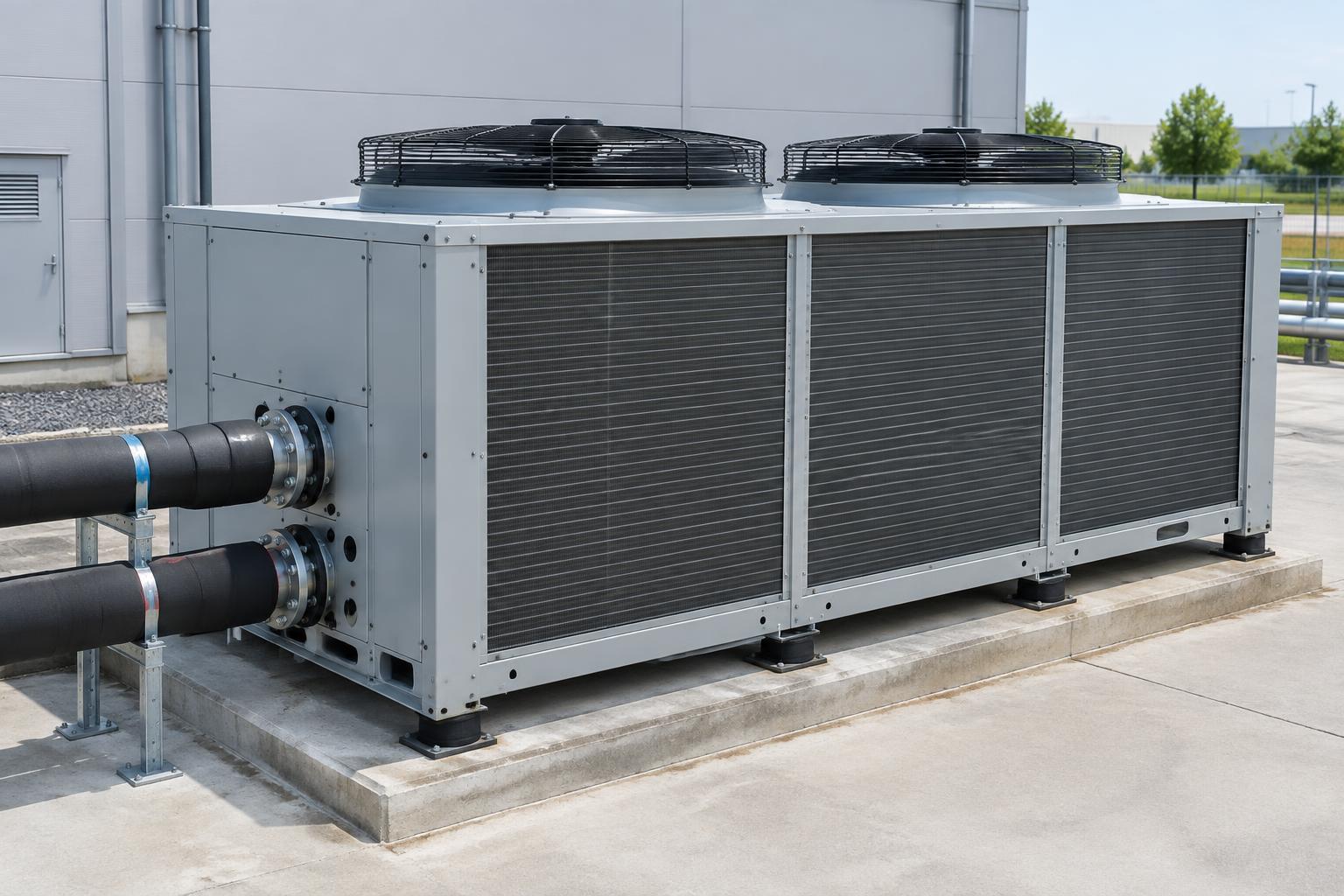
Commercial chiller and chilled water plant
Chiller Repair: scope, checks and next steps
A chiller serves a water circuit as well as a refrigeration circuit. Poor water flow, control demand or heat rejection can limit cooling without a compressor failure.
Separate the possible causes
Review alarms, flow proving, pump status, entering and leaving water conditions and condenser operation. Separate the chiller fault from distribution problems elsewhere in the building.
Repair or replacement?
A plant repair needs to address the original failure conditions. Replacement sizing should use the actual cooling duty, redundancy requirements and existing water circuit—not only the old nameplate rating.
Define the repair and the return-to-service check
A useful repair scope names the affected component, any related fault and the checks needed afterwards. Ask what is included in labour, which parts are additional and how performance will be assessed under the equipment’s normal operating conditions.
Details to include with your job request
Provide the chiller model, alarm history, plant schematic where available and the effect on occupied spaces or process equipment.
Related fault and service guidance
Before your engineer visits
- Photograph the rating plate so we can identify the model and refrigerant.
- Write down when the problem started and whether it is constant or intermittent.
- Move stock out of failing fridges or cold rooms into a working unit if you can.
- Check the isolator and circuit breaker without opening any electrical panels.
- Keep previous service sheets and F-Gas leak-check records ready for the engineer.